By Mega Labourers Services Ltd
To the average person, construction is simply construction.
Blocks are laid.
Concrete is poured.
Roof goes on.
Painting is done.
So many assume that building a family house and building a shopping plaza, office complex, hotel, school, hospital, or warehouse are basically the same process.
But they are not.
In fact:
Residential construction and commercial construction differ in planning, cost, regulations, materials, manpower, timelines, and long-term performance expectations.
This is one of the reasons many investors get into trouble.
Some people approach a commercial project with a residential mindset.
Others overcomplicate a residential project with unnecessary commercial spending.
Both mistakes lead to wasted money.
Before you begin any building project, you need to understand what category of construction you are entering and what it demands.
This guide explains everything clearly.
What Is Residential Construction?
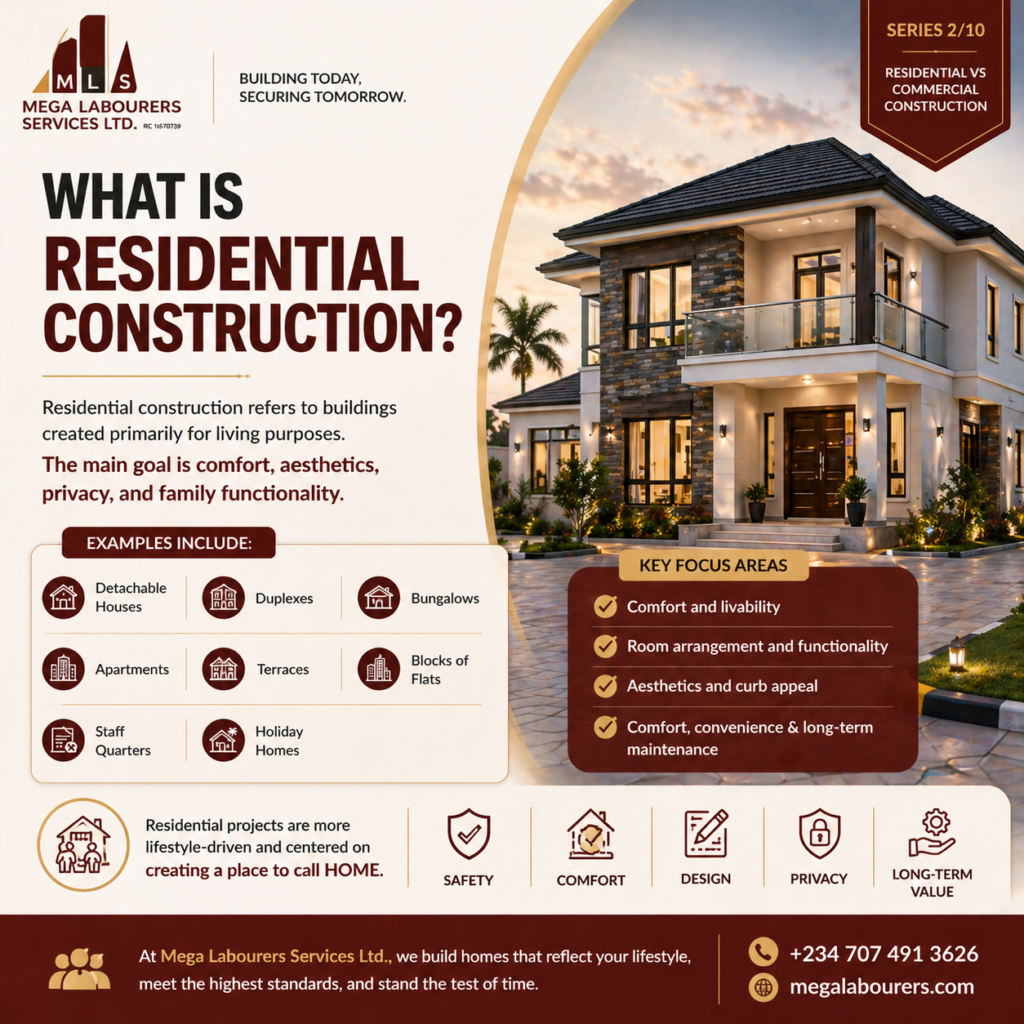
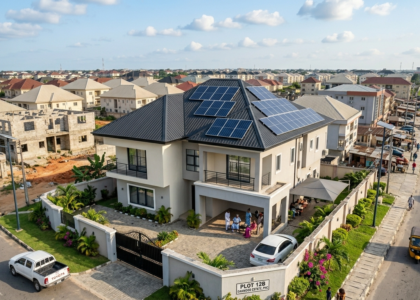
Residential construction refers to buildings created primarily for living purposes.
These include:
- private homes,
- duplexes,
- bungalows,
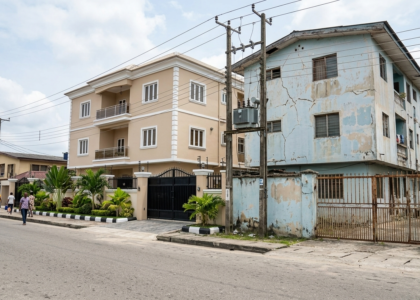
- blocks of flats,
- apartments,
- terraces,
- staff quarters,
- holiday homes.
The primary goal of residential construction is:
comfort, aesthetics, family functionality, privacy, and livability.
In residential projects, the owner is usually emotionally attached because the building is a personal investment or family dream.
That means focus is often on:
- room arrangement,
- beauty,
- convenience,
- kitchen design,
- bedrooms,
- bathrooms,
- compound finishing,
- long-term maintenance comfort.
Residential projects are more lifestyle-driven.
What Is Commercial Construction?
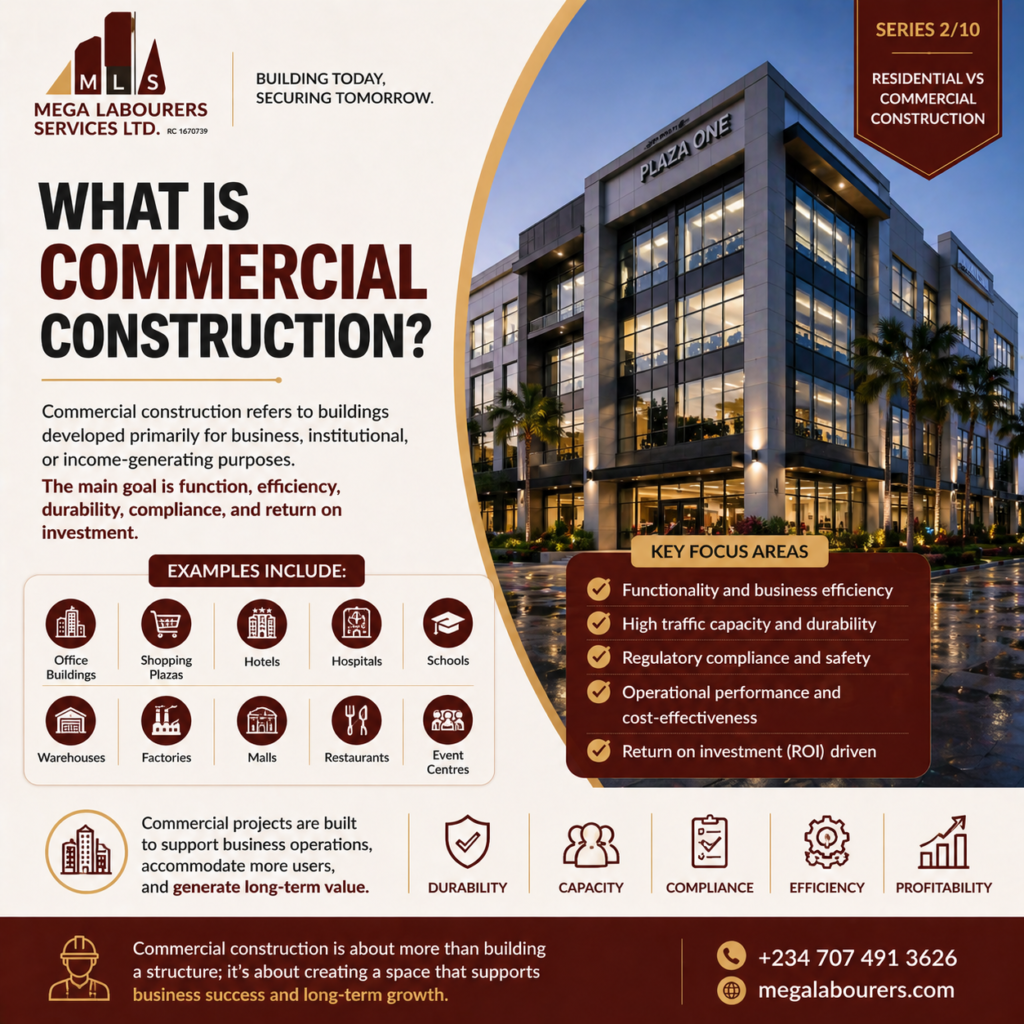
Commercial construction refers to buildings developed primarily for business, institutional, or income-generating purposes.
Examples include:
- office buildings,
- shopping plazas,
- schools,
- hotels,
- hospitals,
- event centres,
- warehouses,
- factories,
- malls,
- restaurants,
- showrooms.
The major goal here is different:
function, traffic flow, durability, regulatory compliance, business efficiency, and return on investment.
Commercial buildings are not built just to look nice.
They are built to handle people, operations, machines, customers, and long-term heavy use.
That changes everything.
1. Planning Complexity Is Very Different
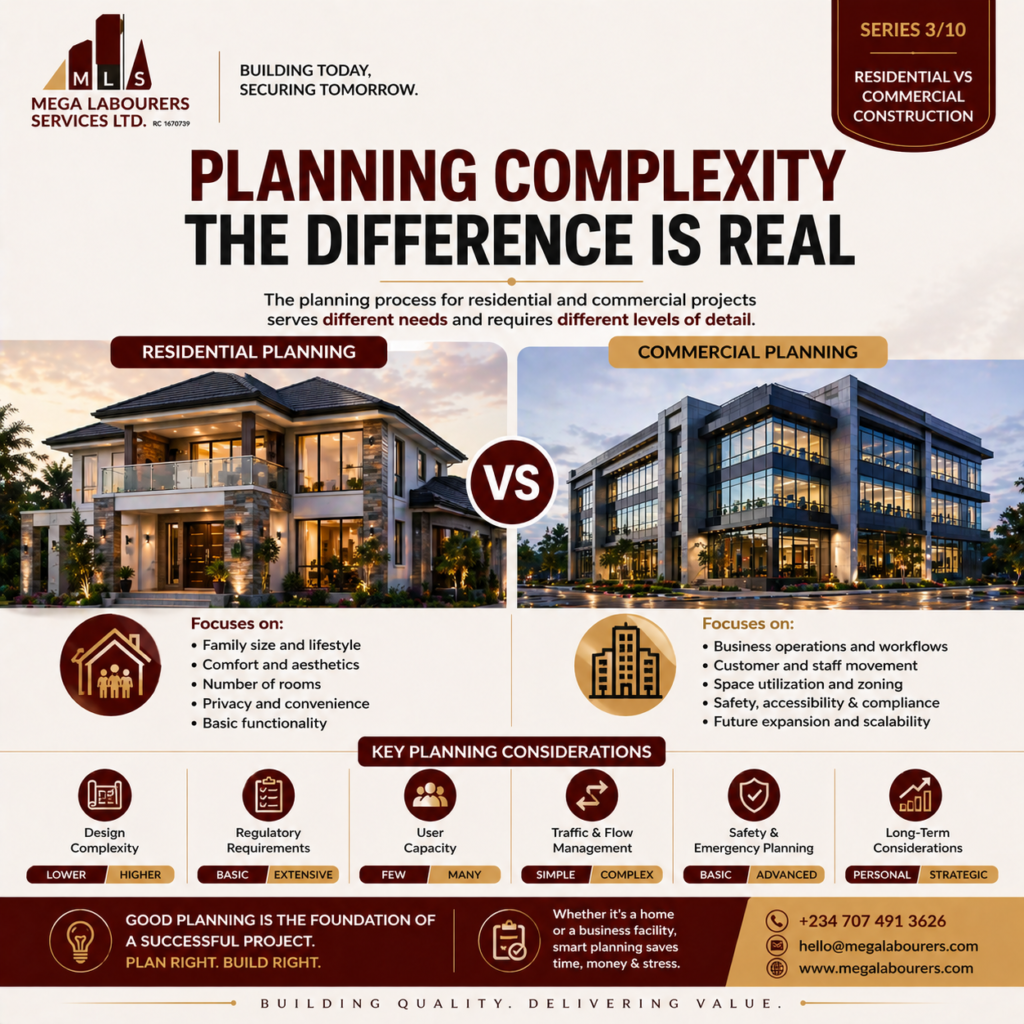
This is where the first major difference starts.
Residential Planning:
Residential planning mostly revolves around:
- family size,
- number of bedrooms,
- parking,
- living comfort,
- ventilation,
- aesthetics.
The design process is usually straightforward.
Commercial Planning:
Commercial planning is much deeper.
You must consider:
- customer movement,
- emergency exits,
- utility systems,
- heavy electrical demand,
- accessibility,
- service areas,
- business workflow,
- parking capacity,
- safety regulations,
- equipment load.
A hotel cannot be planned like a house.
A warehouse cannot be planned like a duplex.
A hospital cannot be designed emotionally.
Commercial projects require technical strategic planning.
2. Structural Load Requirements Are Not The Same
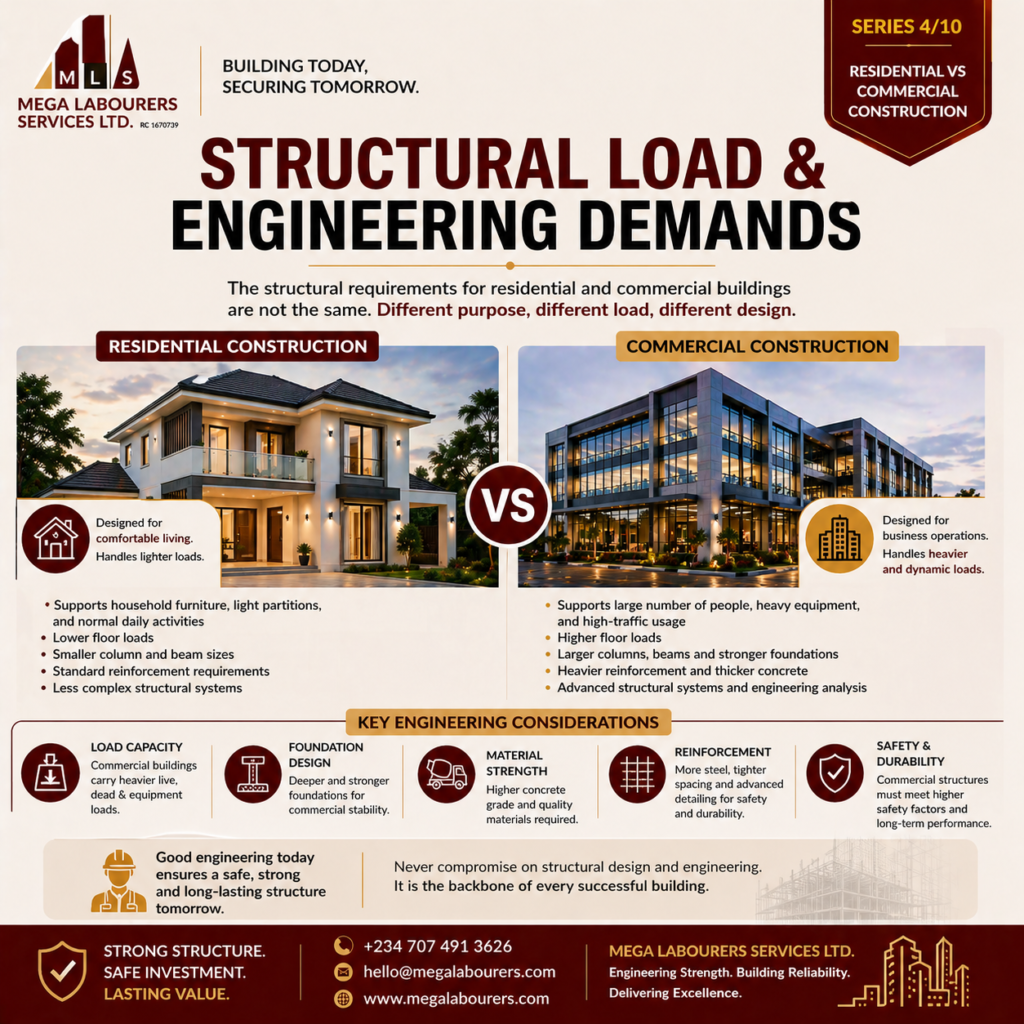
A family home handles:
- household furniture,
- light movement,
- normal daily living.
But a commercial building may carry:
- hundreds of people daily,
- elevators,
- generators,
- industrial machines,
- water systems,
- HVAC systems,
- storage loads,
- retail traffic.
Meaning:
the structural engineering calculations are far heavier in commercial construction.
Foundation depth, slab thickness, beam reinforcement, column sizing, and concrete grade all change significantly.
This is why using ordinary residential construction assumptions on a commercial site can be disastrous.
3. Government Regulations and Compliance Are Stricter in Commercial Projects
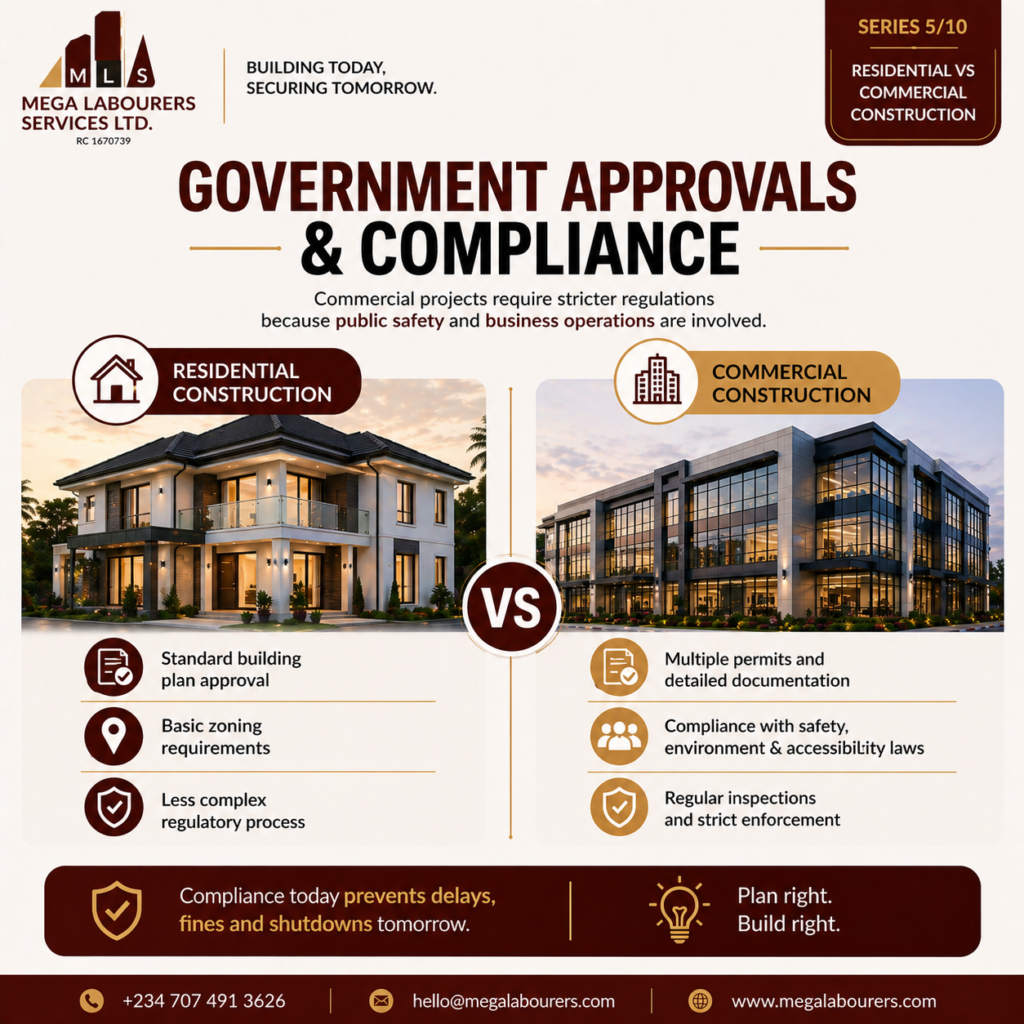
Residential approvals are important.
But commercial approvals are usually far more extensive.
Commercial buildings may require:
- fire safety compliance,
- environmental impact approvals,
- disability accessibility,
- parking regulations,
- public utility standards,
- sanitation permits,
- business zoning permissions.
Government agencies inspect commercial projects much more critically because public use is involved.
Failure here can lead to:
- shutdowns,
- fines,
- redesign costs,
- denied occupancy.
This is why experienced compliance handling is critical.
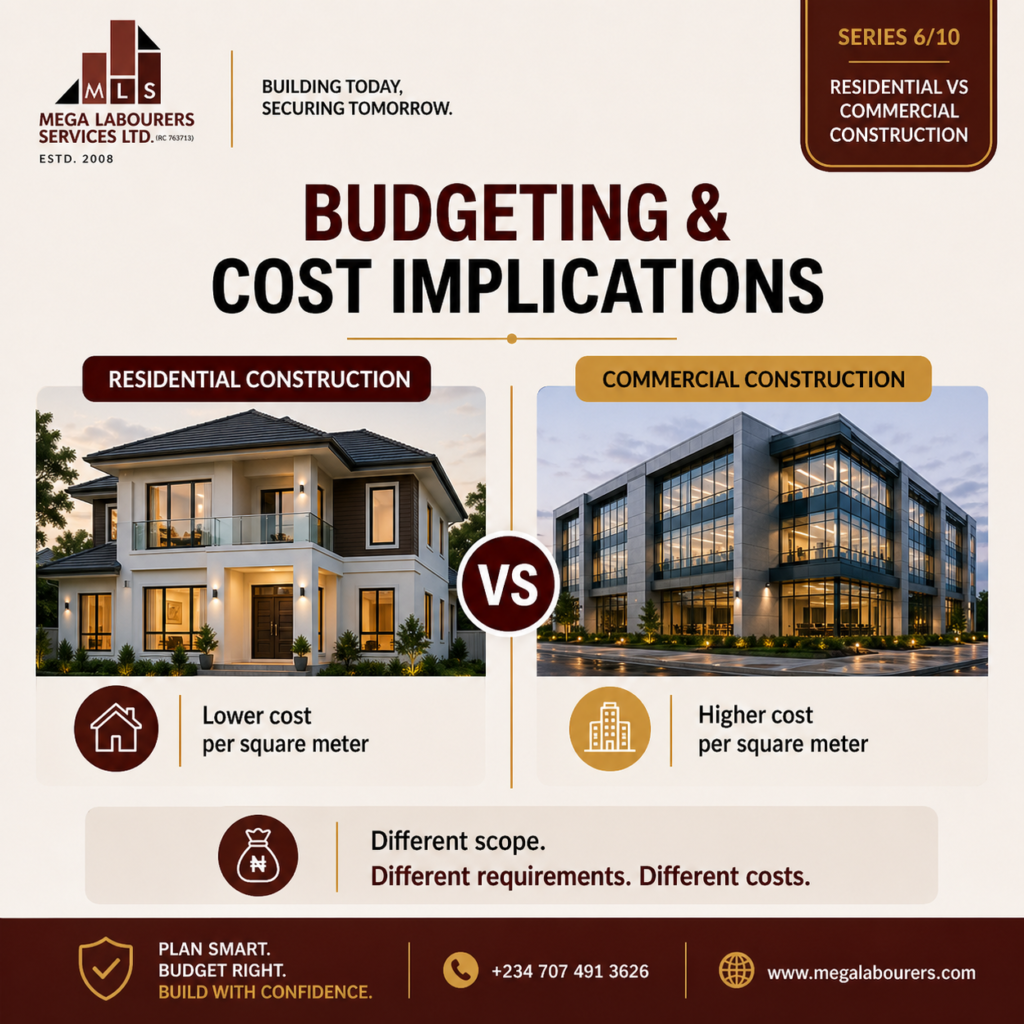
4. Construction Cost Patterns Differ Greatly
Many clients assume:
“Commercial building is just bigger.”
No.
Commercial building is not only bigger — it is more demanding per square meter.
Because commercial buildings require:
- stronger structural systems,
- more electrical installations,
- larger plumbing systems,
- industrial finishes,
- fire systems,
- access systems,
- parking considerations,
- drainage capacity.
Even material specifications are often upgraded.
This means budgeting must be more detailed and contingency must be stronger.
Residential projects may allow more flexibility.
Commercial projects punish poor budgeting very quickly.
5. Construction Timeline Management Is More Sensitive in Commercial Projects
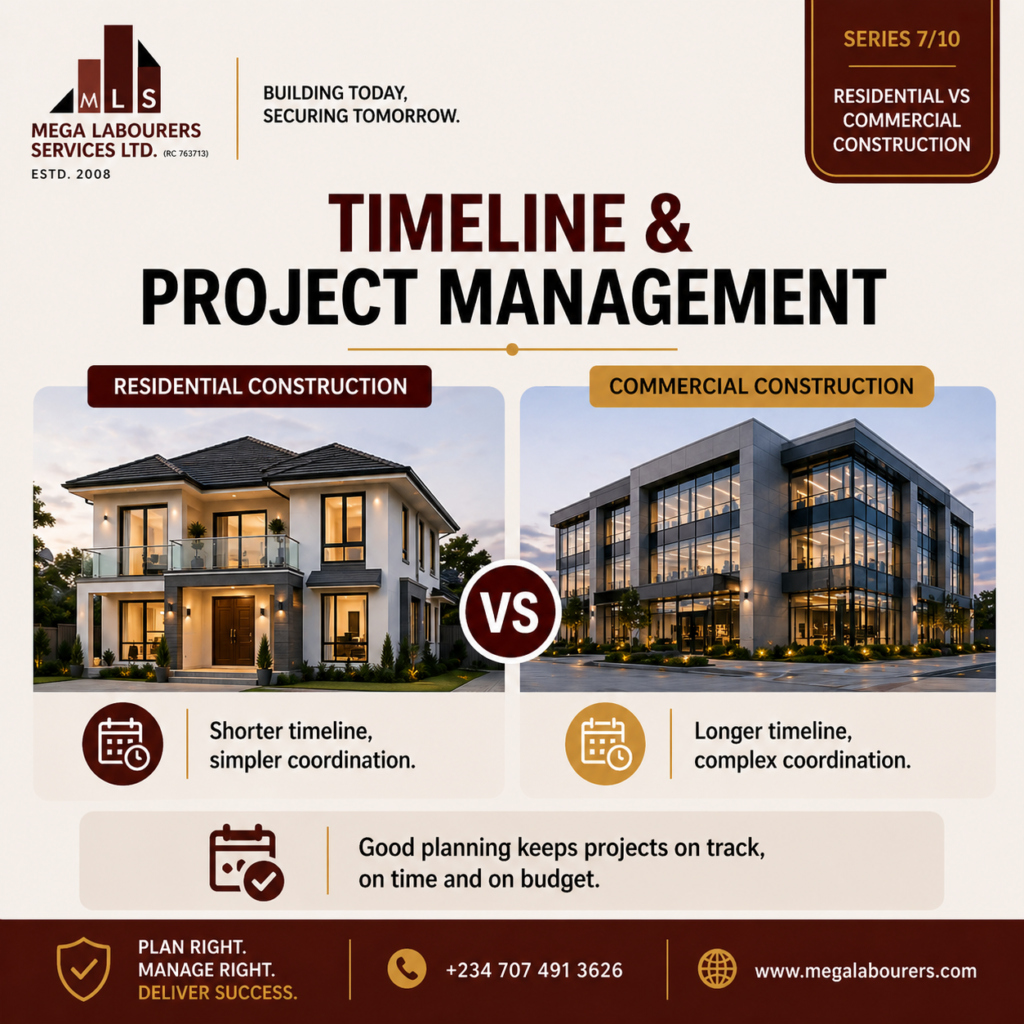
If a family house delays, the owner is frustrated.
If a commercial plaza delays:
income is delayed.
Rental opportunity is delayed.
Business operations are delayed.
Investor repayment is delayed.
Commercial projects are directly tied to revenue.
That means every month of delay has measurable financial consequences.
Commercial construction therefore demands:
- tighter scheduling,
- stricter milestone monitoring,
- coordinated subcontractors,
- procurement discipline.
Time management becomes a business issue, not just a construction issue.
6. Materials Selection Is Different
Residential construction often balances:
- beauty,
- comfort,
- maintenance ease.
Commercial construction balances:
- durability,
- high traffic resistance,
- industrial lifespan,
- low maintenance under pressure.
For example:
Floor tiles in a family sitting room may work perfectly in a home…
but fail quickly in a busy shopping complex.
Doors, plumbing fixtures, lighting systems, stair finishes, glass thickness, railings, ceiling systems — all must be selected differently based on building purpose.
7. Labour and Technical Team Requirements Are Broader in Commercial Construction
Residential jobs may involve:
- architect,
- mason,
- plumber,
- electrician,
- tiler.
Commercial jobs often need:
- civil engineers,
- structural engineers,
- MEP engineers,
- fire safety consultants,
- facility planning experts,
- larger site management teams,
- compliance officers.
This means supervision becomes more technical and documentation heavier.
8. Risk Exposure Is Higher in Commercial Projects

Commercial construction carries bigger risks because:
- more money is involved,
- more users are involved,
- more legal exposure exists,
- more systems can fail.
A plumbing failure in a home affects one family.
A plumbing failure in a hotel affects operations and customer reputation.
An electrical failure in a duplex is a nuisance.
An electrical failure in a hospital is a crisis.
That is why commercial buildings must be built with stronger foresight.
9. Return on Investment Thinking Changes The Entire Build
Residential owners ask:
“Will my family love this?”
Commercial investors ask:
“Will this structure generate and preserve income?”
This changes:
- design decisions,
- maintenance decisions,
- expansion considerations,
- utility planning,
- tenant convenience,
- customer experience.
Commercial construction must think beyond today.
It must think occupancy, operational efficiency, and profitability.
10. Choosing The Right Builder Matters Even More
Not every builder that can build a duplex can handle a commercial complex.
And not every commercial contractor is ideal for a delicate premium residential home.
Each category needs experience-specific understanding.
At Mega Labourers Services Ltd, our team handles:
- residential estates,
- apartment developments,
- commercial structures,
- renovation works,
- concrete and structural projects,
- technical compliance-driven builds,
with a strong focus on quality workmanship, planning precision, and long-term structural value.
So Which One Are You Building?
Before you begin construction, ask yourself:
Is this a lifestyle building or an income building?
Because the answer determines:
- your design approach,
- your budget,
- your approvals,
- your supervision model,
- your contractor selection,
- and your long-term maintenance costs.
Building without understanding this difference is how many projects go wrong from day one.
Build The Right Way With Mega Labourers Services Ltd
Whether you are planning:
- a dream residential home,
- apartment block,
- office plaza,
- warehouse,
- hotel,
- or mixed-use development,
Mega Labourers Services Ltd provides the professional planning, structural expertise, supervision, and complete construction delivery required to ensure your project succeeds from foundation to finishing.